Welding Jacket Burning Through? Upgrade to FR Cotton Before You Get Hurt
If spatter is burning through your jacket, landing on your skin, or leaving holes after every shift, the problem is not “normal wear.” It means the fabric is either not flame-resistant, the FR treatment has worn out, or the jacket weight does not match the spatter intensity of your process. The cost is real: burns, lost time, and a jacket you replace every few weeks instead of every few months.
Across welding forums, the same complaint repeats: “My jacket is full of holes after two weeks.” The root cause is almost always one of two things — the jacket was never FR-rated, or the welder bought a heavy leather jacket that was too hot to wear all day and ended up welding without it. The fix is a jacket that is actually FR-rated AND comfortable enough to keep on during the entire shift.
Featured Product Quick Take
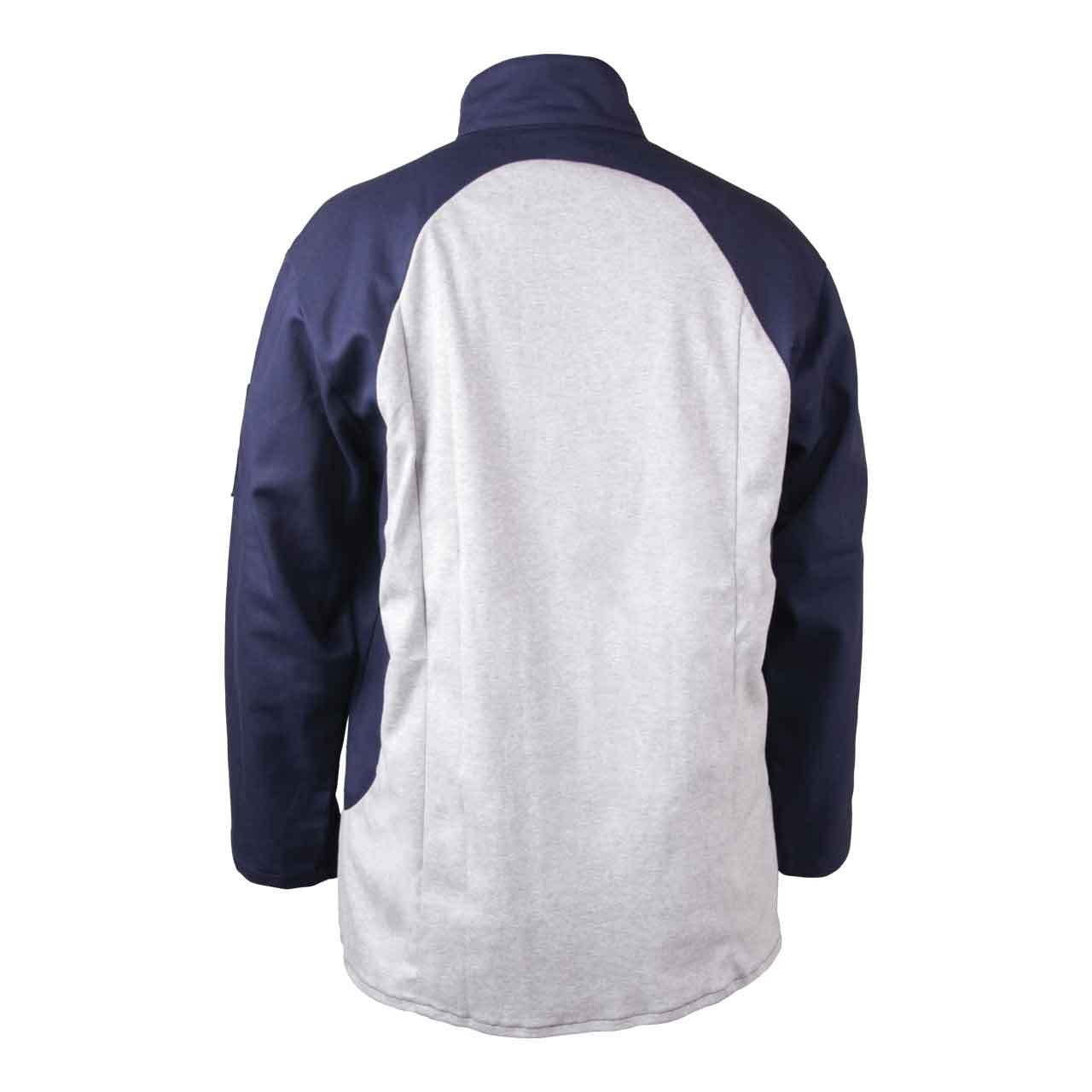
- Name: Black Stallion JF1625-NG Stretch-Back FR Cotton Welding Jacket, Navy/Gray, Large
- SKU: JF1625-L
- Price: Unknown (Verify)
- What it fixes: spatter and spark burn-through caused by non-FR or worn-out welding jackets that can no longer self-extinguish or resist heat penetration during MIG, stick, and grinding work.
- Why it matters: a jacket that lets spatter through is not just uncomfortable — it is a burn hazard. FR cotton self-extinguishes when the ignition source is removed. A stretch-back panel adds mobility so you actually keep the jacket on instead of taking it off when it gets hot.
- •Brand: Black Stallion (product page)
- •SKU: JF1625-L (product page)
- •Front and sleeves: 9 oz. FR cotton (product page)
- •Back panel: 7 oz. FR cotton stretch knit with looped knit yarns (product page)
- •Collar: Stand-up collar for spark/heat protection (product page)
- •Closures: Six powder-coated stainless steel snaps + wrist snaps (product page)
- •Pockets: Scribe pocket + inside pocket (product page)
- •Length: 32 inches (product page)
- •Sizes available: S–4XL (product page)
- •Application: Light welding, cutting, grinding (product page)
- •FR certification standard: Unknown (Verify)
Welding jackets are sized by chest measurement. If you are between sizes, go up — a jacket that is too tight restricts movement and creates gaps at the wrists and waist where sparks enter.
What This Fix Solves
- •Spatter burning through the jacket fabric and reaching skin
- •Jacket that smolders or holds a flame after a spark lands on it
- •Burn holes accumulating after a few weeks of daily MIG or stick work
- •Overheating and restricted movement that makes you take the jacket off mid-weld
- •Wrist and waist gaps that let sparks inside because the jacket is too stiff to move in
Root Cause Breakdown
- Non-FR fabric (the jacket was never rated for welding): Standard cotton, denim, and polyester are not flame-resistant. They can ignite, melt, or burn through when hit by welding spatter. This is the most common root cause — the jacket looks like a welding jacket but is not FR-rated.
- FR treatment worn out from washing or age: Some FR treatments degrade over time, especially with improper washing (bleach, fabric softener, high heat drying). Once the treatment is gone, the fabric behaves like non-FR cotton.
- Wrong weight for the process: A lightweight FR shirt may be fine for TIG but not for heavy MIG or stick work. Heavier spatter from short-circuit MIG and stick welding requires heavier FR fabric or leather in the strike zone.
- Poor fit creating exposure gaps: A jacket that is too tight rides up at the waist and pulls back at the wrists. Sparks enter through the gaps. A jacket that is too stiff gets taken off when it is hot — which defeats the purpose.
- Jacket too stiff or hot to wear all day: Heavy leather jackets provide excellent protection but can be too hot for extended wear in warm shops. When welders take the jacket off to cool down, they lose protection during the most dangerous part of the job.
The Fix (Actionable Steps)
- Check the label: confirm your current jacket is actually FR-rated. If there is no FR certification on the tag, it is not a welding jacket — replace it.
- Inspect for burn-through: if you see holes, thin spots, or areas where spatter has penetrated, the jacket has reached end of life regardless of FR rating.
- Match jacket weight to your process: 9 oz. FR cotton (like the JF1625-NG front) handles light-to-moderate MIG, stick, and grinding. For heavy stick or gouging, consider leather or heavier FR cotton.
- Size correctly: measure your chest and compare to the manufacturer size chart. If between sizes, go up. The JF1625-NG is available in S–4XL (product page).
- Confirm the jacket allows movement: the JF1625-NG uses a 7 oz. FR cotton stretch knit back panel that flexes with your body. This reduces the "take it off because it's too hot" problem.
- Wash per FR care instructions: no bleach, no fabric softener, tumble dry low or line dry. Improper washing degrades FR performance over time.
Note: FR clothing has care requirements. Follow the manufacturer wash instructions to maintain flame-resistant performance. Bleach, fabric softener, and high-heat drying can degrade FR treatments.
Key Specs / Fitment Notes (Bullets Only)
- •Product: Black Stallion JF1625-NG Stretch-Back FR Cotton Welding Jacket (product page)
- •SKU: JF1625-L (product page)
- •Front/sleeves: 9 oz. FR cotton (product page)
- •Back: 7 oz. FR cotton stretch knit (product page)
- •Collar: Stand-up (product page)
- •Snaps: Six powder-coated stainless steel + wrist snaps (product page)
- •Length: 32 inches (product page)
- •Sizes: S–4XL (product page)
- •FR certification standard: Unknown (Verify)
Before You Order Checklist
- Machine: welder make/model (for context — drives spatter intensity)
- Process: MIG / Stick / TIG / Plasma / Grinding
- Material: mild steel / stainless / aluminum (affects spatter type)
- Thickness: typical range (drives amperage and spatter volume)
- Consumables: N/A (jacket) — but note if you do heavy spatter work
- Torch/gun: N/A (jacket)
- Gas: N/A (jacket) — but CO2-heavy mixes produce more spatter
The most common wrong order for welding jackets is size. Measure your chest and compare to the manufacturer size chart. If between sizes, go up — a tight jacket creates gaps where sparks enter.
Recommended Accessories (Priority Order)
Comparison Block (Alternatives)
Best balance of protection and comfort for daily light-to-moderate welding. 9 oz. FR cotton front resists spatter; stretch-back panel reduces heat buildup and improves mobility.
Maximum spatter protection for heavy stick, gouging, and overhead work. Heavier and hotter — some welders take it off in warm shops, which defeats the purpose.
Not rated for welding. Can ignite, melt, or burn through. If your jacket does not have an FR tag, it is not protecting you.
Safety Note
Welding jackets are part of your safety system. Do not weld in non-FR clothing. Inspect your jacket before each shift for burn-through, holes, and worn areas. Replace jackets that can no longer self-extinguish or resist spatter penetration. Follow the manufacturer care instructions to maintain FR performance. If you are unsure whether your jacket is still FR-rated, treat it as non-FR and replace it.
Add to Cart — or Confirm Size First
Add the Black Stallion JF1625-NG FR welding jacket to your cart. Available in S–4XL. Not sure on size? Call 812-738-4344 with your chest measurement and typical process.