TIG Gas Coverage Weak? Upgrade to a Gas Saver Kit With Glass Cup Before You Crank the Flow
If your TIG welds oxidize when you extend the tungsten past the cup, or your stainless bead color goes from gold to gray without warning, the root cause is usually gas coverage — not amperage, not technique, and not the tungsten. Across TIG forums, the same pattern shows up: welders crank argon flow to compensate for poor coverage, which creates turbulence and actually makes shielding worse.
The real fix is changing how the gas reaches the work. A gas saver setup produces laminar (smooth) flow that holds together over longer distances. Add a glass cup, and you get direct visibility into the puddle — so you can see exactly where the tungsten is, how the shielding looks, and whether your stick-out is right before you commit to a bead.
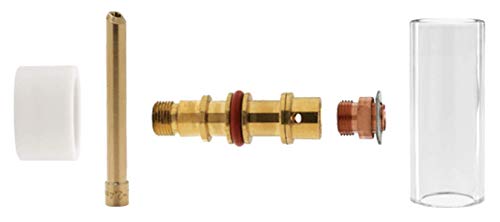
Featured Product Quick Take
- Name: CK D3GS418-P Gas Saver Kit for 1/8" w/Glass Cup
- SKU: D3GS418-P
- Price: Unknown (Verify)
- What it fixes: poor TIG shielding gas coverage caused by turbulent flow through standard alumina cups — especially noticeable on longer stick-out, stainless steel, and tight joints where you need both coverage and visibility.
- Why it matters: a gas saver setup produces laminar (smooth) argon flow that holds together over longer distances. The glass cup adds direct puddle visibility so you can see exactly where the tungsten is relative to the joint. Less argon waste, fewer oxidation callbacks, and faster setup on stainless and thin material.
- •Brand: CK Worldwide (product page)
- •SKU: D3GS418-P (product page)
- •Tungsten size: 1/8" (product title)
- •Cup type: Glass (product title)
- •Kit type: Gas saver kit (product title)
- •Torch family compatibility: Unknown (Verify — likely #17/#18/#26 based on CK product line)
- •Included components list: Unknown (Verify)
- •Cup size (number): Unknown (Verify)
Gas saver kits are torch-family and tungsten-size specific. Confirm your torch model (#17/#18/#26 vs #9/#20) and tungsten diameter (1/8") before ordering. If anything is unclear, treat it as Unknown (Verify).
What This Fix Solves
- •Oxidation or sugaring on stainless that appears when you extend stick-out beyond the cup
- •Argon consumption that feels too high for the work you are doing
- •Poor puddle visibility with opaque alumina cups (you cannot see the tungsten tip or joint)
- •Shielding that breaks down in light drafts or when you angle the torch
- •Inconsistent bead color on stainless or titanium even with correct flow settings
Root Cause Breakdown
- Turbulent gas flow from standard collet bodies: Standard (non-lens) collet bodies create turbulent argon flow that breaks apart quickly after leaving the cup. The shorter the distance from cup to work, the more forgiving this is — but extend stick-out or add a draft, and coverage fails.
- Cup size too small for the joint: A smaller cup concentrates flow but covers less area. On wider joints or when you need to extend the tungsten, a small standard cup cannot maintain coverage across the full heat-affected zone.
- No visibility into the puddle: Opaque alumina cups block your view of the tungsten tip and the leading edge of the puddle. You end up guessing stick-out distance and torch angle, which leads to dips, contamination, and inconsistent starts.
- Compensating with excessive flow: When coverage feels weak, the instinct is to crank up the flow. But excessive flow creates turbulence at the cup exit, which can actually pull air into the shielding stream — making the problem worse and wasting argon.
- Wrong front-end stack for the application: Mixing standard collet bodies with gas lens cups (or vice versa) creates fitment issues and inconsistent gas delivery. The entire front-end stack must be matched: collet body, collet, cup, and back cap.
The Fix (Actionable Steps)
- Identify the symptom: if oxidation appears when you extend stick-out or angle the torch, suspect gas coverage — not amperage or technique.
- Confirm your torch family (#17/#18/#26 vs #9/#20) and tungsten diameter (1/8" for this kit). Parts do not interchange between families.
- Install the gas saver kit as a complete front-end stack. Do not mix gas saver components with standard collet body parts.
- Set argon flow conservatively. Gas saver setups produce laminar flow, so you often need less CFH than you did with a standard setup. Start at your normal baseline and reduce if the bead color is consistent.
- Use the glass cup visibility to verify stick-out and torch angle before you strike the arc. Adjust position so you can see the tungsten tip relative to the joint.
- Re-test on clean stainless or the material that was giving you trouble. If bead color is consistent and oxidation is gone, the root cause was gas coverage.
Note: We are not publishing fixed CFH numbers because flow depends on cup size, stick-out, draft conditions, and joint geometry. The goal is stable, laminar coverage — not maximum flow.
Key Specs / Fitment Notes (Bullets Only)
- •Product: CK D3GS418-P Gas Saver Kit for 1/8" w/Glass Cup (product title)
- •SKU: D3GS418-P (product page)
- •Brand: CK Worldwide (product page)
- •Tungsten size: 1/8" (product title)
- •Cup material: Glass (product title)
- •Torch family compatibility: Unknown (Verify)
- •Included components: Unknown (Verify)
- •Cup size number: Unknown (Verify)
Before You Order Checklist
- Machine: welder make/model
- Process: TIG (DCEN for steel/stainless, AC for aluminum)
- Material: stainless / mild steel / aluminum / titanium
- Thickness: typical range (drives amperage and cup size)
- Consumables: tungsten diameter (1/8"), current cup size, collet body style
- Torch/gun: torch model and family (#17/#18/#26 vs #9/#20)
- Gas: argon flow rate, cup size, draft conditions
Fastest confirmation: call 812-738-4344 with your torch model, tungsten diameter, and the material you weld most. We will confirm the correct gas saver kit before you order.
Recommended Accessories (Priority Order)
Comparison Block (Alternatives)
Best when you need extended stick-out, better gas coverage, and puddle visibility. Reduces argon waste and improves bead color consistency on stainless.
Works for short stick-out in calm conditions. More affordable per cup, but turbulent flow breaks down faster and you cannot see the puddle.
Improves gas coverage over standard, but you still lose puddle visibility. Good middle ground if glass cup fragility is a concern.
Safety Note
Shielding gas can displace oxygen in confined spaces. Use adequate ventilation and secure cylinders properly. Glass cups are more fragile than alumina — inspect before each use and replace cracked cups immediately. Do not modify torch parts to make them fit. If you are unsure about torch family or consumable stack, stop and verify before ordering.
Add to Cart — or Confirm Torch Family First
Add the CK D3GS418-P gas saver kit to your cart if you can confirm your torch is #17/#18/#26 family and you run 1/8" tungsten. Not sure? Call 812-738-4344 with machine model + process + thickness.