How to Reduce MIG Spatter Buildup: 5 Root Causes & the Fix
Excessive MIG spatter is one of the most common and most expensive arc quality problems in production welding. It clogs nozzles, wears out contact tips faster, and adds grinding time to every joint. Across welding forums, the same pattern repeats: spatter that gets worse over time is usually a consumable or setup issue, not a settings issue.
Featured Product Quick Take
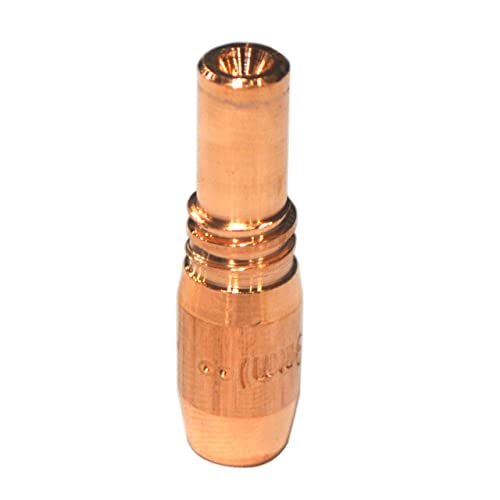
- Name: Bernard AccuLock S Contact Tip .035 (TA035CH) (10pk)
- SKU: TA035CH
- Price: Unknown (Verify)
- What it fixes: excessive MIG spatter caused by worn or wrong-size contact tips that degrade current transfer and destabilize the arc.
- Why it matters: stable current transfer means a smoother arc, less spatter, fewer tip changes, and less time grinding cleanup.
- •Brand: Bernard (from product page)
- •System: AccuLock S (from product page)
- •Wire size: .035" (from product title)
- •Pack size: 10 (from product title)
- •Compatible guns: Bernard/Miller MDX AccuLock S series (verify your gun model)
- •Tip style/threading: AccuLock S proprietary (not interchangeable with standard threaded tips)
AccuLock S tips are NOT interchangeable with standard threaded tips. Confirm your gun is AccuLock S before ordering.
What This Fix Solves
- •Spatter buildup on nozzle that requires frequent cleaning or replacement
- •Contact tips wearing out faster than expected
- •Arc instability that produces erratic spatter patterns
- •Extra grinding and cleanup time on every weld joint
- •Spatter that gets worse over a shift as consumables degrade
Root Cause Breakdown (5 Causes of Excessive MIG Spatter)
- Worn or wrong-size contact tip: a worn tip creates poor current transfer and micro-arcing inside the bore. Wrong size (too tight or too loose for the wire) increases resistance and instability. Both produce more spatter.
- Nozzle spatter buildup restricting gas flow: spatter inside the nozzle disrupts shielding gas coverage. Poor coverage lets atmospheric gases contaminate the arc, which increases spatter in a feedback loop.
- Incorrect wire feed speed / voltage balance: too much wire speed for the voltage (or vice versa) creates an unstable transfer mode. This is the most commonly blamed cause but it is often secondary to consumable condition.
- Wire feed instability: drive roll slip, liner drag, or spool brake issues cause the wire to surge. Each surge produces a spatter spike. Fix the feed system before chasing settings.
- Contaminated base metal or wire: oil, rust, paint, and mill scale release gas into the puddle. This creates porosity and spatter simultaneously. Prep the weld zone and store wire properly.
The Fix (Actionable Steps)
- Replace the contact tip: do not try to clean a worn tip. Install a fresh tip that matches your wire size AND consumable system (AccuLock S tips are not interchangeable with standard threaded tips).
- Clean or replace the nozzle: remove spatter buildup from inside the nozzle. If the bore is damaged or heavily pitted, replace it. Apply anti-spatter dip to the clean nozzle.
- Check nozzle-to-tip recess: the contact tip should be recessed inside the nozzle per your gun manufacturer spec. Too much or too little recess changes the arc characteristics and spatter behavior.
- Verify wire feed stability: confirm drive roll groove matches wire type (V-groove for solid wire), tension is set correctly (about 1/2-turn past wire slippage), and liner is not kinked or worn.
- Confirm gas flow: leak-check connections, verify flow rate with a flow gauge regulator, and confirm the nozzle is not restricting shielding coverage.
- Then adjust settings: only after consumables and feed are confirmed correct, fine-tune voltage and wire feed speed for the joint. Chasing settings with bad consumables wastes time.
Key Specs / Fitment Notes (Bullets Only)
- •Brand: Bernard (from product page)
- •System: AccuLock S (from product page)
- •Wire size: .035" (from product title)
- •Pack size: 10 (from product title)
- •Compatible guns: Bernard/Miller MDX AccuLock S series (verify your gun model)
- •Tip style/threading: AccuLock S proprietary (not interchangeable with standard threaded tips)
Before You Order Checklist
- Machine: welder make/model + feeder model (if separate)
- Process: MIG (solid wire) vs flux-core
- Material: mild steel / stainless / aluminum
- Thickness: typical range you weld
- Consumables: .035 contact tip + matching nozzle + diffuser (AccuLock S system)
- Torch/gun: gun brand/model + consumable family (AccuLock S vs standard)
- Gas: C25 vs 100% CO2 vs other mix (verify)
Fitment note: the most common wrong order for contact tips is system mismatch (AccuLock S vs standard threaded). Confirm your gun model before ordering.
Recommended Accessories (Priority Order)
Comparison Block (Alternatives)
Designed for the AccuLock S consumable system. Consistent bore, reliable current transfer. Verify your gun family before ordering.
Common on many guns. NOT interchangeable with AccuLock S. If your gun uses standard tips, match to your gun brand and wire size.
Helps prevent spatter adhesion to the nozzle but does NOT fix the root cause. Use in addition to correct consumables, not instead of.
Safety Note
Power down the feeder before changing consumables. Keep hands clear of pinch points when opening the drive system. Wear ANSI Z87.1 rated eye protection when grinding spatter. Do not bypass safety devices. Follow your equipment manual and applicable ANSI/AWS safety requirements.
Add to Cart — or Confirm Fitment First
Add the Bernard AccuLock S .035 contact tips (TA035CH) to your cart. Not sure if your gun is AccuLock S? Call with your gun model, wire diameter, and typical thickness.